By Ramsha Irfan modified Jan 07, 2026
~ 2 minutes to read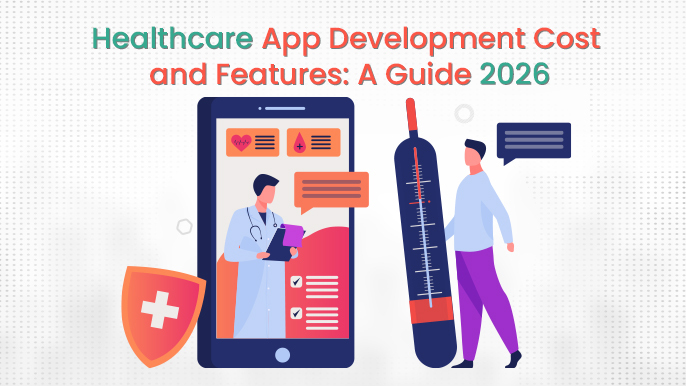
The healthcare apps of today are transforming the way people manage their health, communicate with healthcare providers, and access care on a daily basis. With continuous modifications in areas of telemedicine and remote patient monitoring, digital health solutions have become the greatest demand across the industry.
This has led to the complexity of developing a healthcare app that is secure, powerful, and scalable. Below, we have shared an ultimate guide that will help readers learn everything they need to know about the healthcare app development cost in 2026. Our experts have analyzed the pricing, statistics, and features that are necessary for building a seamless product.
No matter if you are reading as an entrepreneur or a tech expert, this guide will make sure you budget wisely and take the right steps.
Professionals must know that developing a healthcare app is not about using a cookie-cutter strategy. Below, we have shared the different cost ranges based on the complexity and app type.
|
App Type |
Development Cost ($) |
Typical Use Case |
|
Basic App |
$30,000 – $80,000 |
Simple features: appointment booking, profiles, push notifications. (Kaopiz) |
|
Medium Complexity |
$80,000 – $150,000 |
Telemedicine, chats, payment, basic EHR integration. (Pravaah Consulting) |
|
Advanced App |
$150,000 – $300,000 |
Integrated analytics, wearable/IoT connectivity, video consultations. (Pi Tech) |
|
Enterprise-Grade |
$300,000 – $500,000+ |
AI analytics, multiple integrations, robust backend, scalable infrastructure. (Kaopiz) |
These figures analyze their entire life cycle of the website, including the design, development, testing, deployment, and initial launch phases.
By exploring the factors that influence healthcare app development cost, you can always plan intelligently.
Budget Tip: Allocate 20–30% of your total budget, particularly towards the compliance and security of your app.
It is important to learn about the primary feature set and integrations, along with their cost impact.
Core Features:
Feature Cost Influence:
|
Feature |
Impact on Budget |
|
Telemedicine (video chat) |
Moderate to High |
|
EHR/EMR integration |
High |
|
Payment gateway |
Medium |
|
Wearable & IoT support |
High |
|
AI symptom checker |
Very High |
Every advanced-level feature increases the time of development, testing, and compliance. This results in a significant cost increase.
Professionals must remember that cross-platform app development costs approximately 30-40% less as compared to the price of an entirely separate native app.
Business owners must understand that geography directly affects pricing.
Keep in mind that choosing the right mobile app development company with deep healthcare experience can also reduce overall cost. It is because there are fewer chances of rework and compliance risks.
Below, we have mentioned the primary features that many apps should include. These can help your venture stand out.
Must-Have Features:
By incorporating these features, you can easily launch a Minimal Viable Product (MVP) and validate your idea early.
These features are higher-level and add value to the app, along with an increase in development cost.
Incorporating these features into the app can significantly boost scalability and user engagement. However, each of these can directly increase the cost of development.
Below, we have shared a realistic model that you can use as a planning tool.
|
Feature Bundle |
Typical Budget |
Timeline |
|
Basic MVP |
~$30K–$80K |
3–5 months |
|
Telemedicine App |
~$80K–$150K |
4–6 months |
|
Advanced Health App |
~$150K–$300K |
6–9 months |
|
Enterprise Solution |
$300K+ |
9–12+ months |
Remember that the actual costs may vary on the basis of feature complexity, backend infrastructure, regional rates, and compliance demand.
Always start with a lean MVP web development consisting of core features. It lowers the risk and offers the chance to test market response early.
Are you looking for a clear MVP roadmap that completely suits your idea?
Find a recognized mobile app development company now.
Get your MVP scooped!
Entrepreneurs must know that not paying attention to regulatory planning can result in increasing the rework cost in the future.
A professional-grade agency understands that development does not end at launch. There are post-development requirements like security patches, OS updates, and feature releases that add ongoing costs.
Try to maintain a budget by evaluating 15–25% of your initial build cost for annual maintenance.
Focus on a few ways to control your investments.
To conclude, the healthcare app landscape in 2026 is full of opportunities. However, it is necessary to understand that building a secure, compliant, and user-friendly app is not a one-time effort. It demands intelligent planning and realistic budgeting.
No matter if you are developing a telemedicine platform or designing a remote monitoring solution. It is mandatory to understand the cost drivers and feature priorities, as it will result in building a smarter app.
Ramsha is a talented writer known for top-quality content on trending topics. Her excellence in research enables her to add value to businesses by driving online traffic with engaging and persuasive content.